Communicating the Value of UCORE to Students
UCORE’s value is not often immediately obvious to students. Advisors are critical in moving students away from thinking about UCORE (or really any graduation requirement) as simply a box to check and instead toward thinking of UCORE as an experience to embrace for the purposes of exploration, intellectual growth, and the acquisition and development of broadly-applicable skills.
Employers frequently cite adaptable or transferable skills and broad engagement with the world as more important than one’s chosen major.
Conveying this message to students requires elucidation and resolve. It is a given that advisors will need to assist students with the mechanics of navigating the UCORE curriculum with reference to graduation requirements. The challenge is helping them to comprehend the intended spirit of the requirements.
Strategies for Advising Students Effectively
- Communicate the post-graduation return on investment. Technological priorities and modes of operation change constantly. Employers want adaptable and creative thinkers, not narrow ones. Encourage students to begin thinking about marketing themselves with WSU’s undergraduate learning outcomes in mind.
- Prioritize student interest and discovery over scheduling convenience. Discuss with students their interests and goals. What are they curious about? What social, philosophical, scientific, or technological issues do they care about? Are there particular skills they wish to develop further that are not tied to any particular major? Help them build a UCORE plan with these answers at the center and to make room for interesting things.
- Empower students to take ownership over their learning. UCORE offers a scaffolded set of skills and areas of knowledge. It is in large part up to students to chart courses that help them reach their intellectual goals. But they have to know that that is possible.
UCORE and Employee Skills
Consider the following list of skills, most of which are the focus of UCORE, and the emphasis placed on said skills by employers…
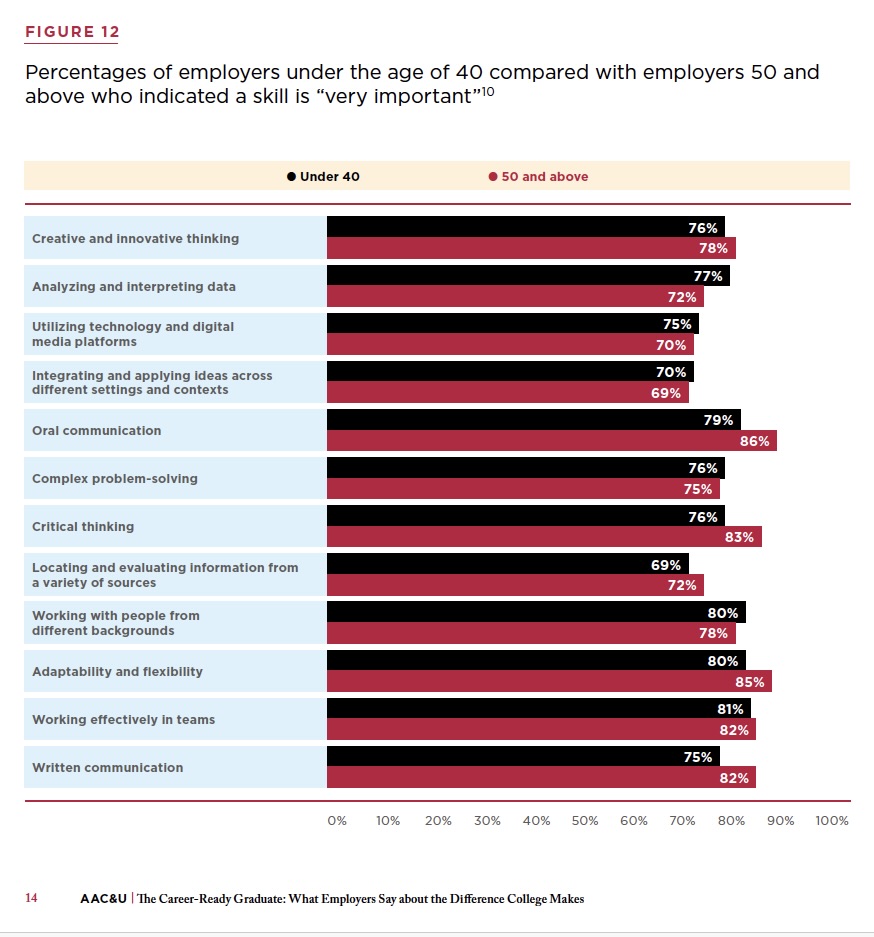
| Career-ready Skill | Employers Under the Age of 40 | Employers Age 50 and Above |
|---|---|---|
| Creative and innovative thinking | 76% | 78% |
| Analyzing and interpreting data | 77% | 72% |
| Utilizing technology and digital media platforms | 75% | 70% |
| Integrating and applying ideas across different settings and contexts | 70% | 69% |
| Oral communication | 79% | 86% |
| Complex problem-solving | 76% | 75% |
| Critical thinking | 76% | 83% |
| Locating and evaluating information from a variety of sources | 69% | 72% |
| Working with people from different backgrounds | 80% | 78% |
| Adaptability and flexibility | 80% | 85% |
| Working effectively in teams | 81% | 82% |
| Written communication | 75% | 82% |